Neuroprotective and Neurotoxic Signaling by the Prion Protein
Resenberger UK, Winklhofer KF, Tatzelt J.
20.05.2011
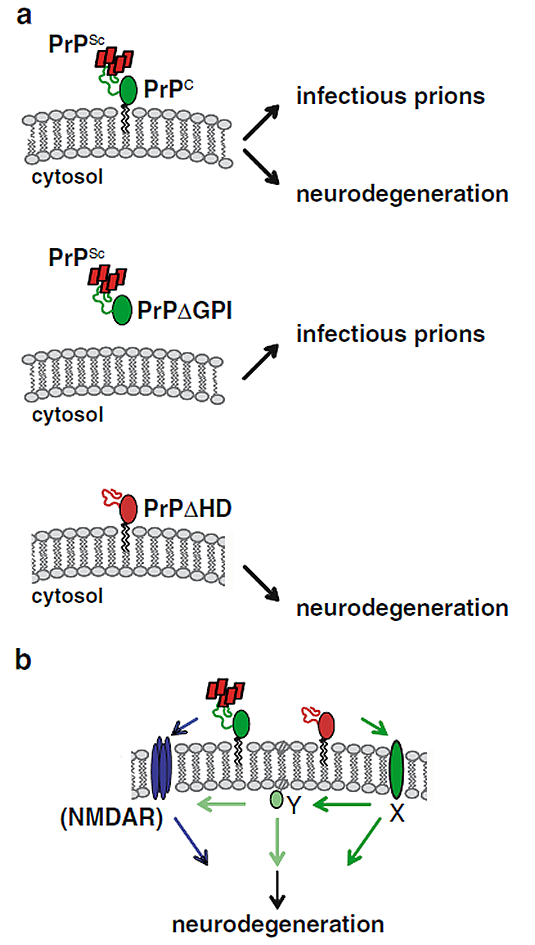
Propagation of infectious prions and neurodegeneration in prion diseases. (a) Propagation of infectious prions and neurodegeneration can occur independently. In the majority of prion diseases there is a correlation between the accumulation of PrPSc, formation of infectious prions, and neurodegeneration, which is dependent on the expression of GPI-anchored PrP in neuronal cells (upper panel). Infection of transgenic mice expressing an anchorless PrP mutant (PrPDGPI) results in the formation of infectious prions; however, the onset of clinical symptoms is at least significantly delayed (middle panel). Expression of a PrP mutant with a deletions in the internal hydrophobic domain (PrPDHD) induces neuronal cell death in the absence of prion propagation (lower panel). (b) Putative model of toxic signaling induced by PrPSc or PrPDHD at the plasma membrane. Since PrPC has no direct contact to the cytosolic compartment, it is plausible to assume that intracellular signal transmission induced by PrPSc or PrPDHD involves additional cellular factors, such as different transmembrane proteins (X), and/or cytosolic proteins associated with lipid rafts (Y). Activation of the NMDA receptor (NMDAR) could be involved either directly through an interaction with pathogenic PrP conformers or indirectly via modulation by cytosolic factors.
ABSTRACT
Prion diseases in humans and animals are characterized by progressive neurodegeneration and the formation of infectious particles called prions. Both features are intimately linked to a conformational transition of the cellular prion protein (PrP(C)) into aberrantly folded conformers with neurotoxic and self-replicating activities. Interestingly, there is increasing evidence that the infectious and neurotoxic properties of PrP conformers are not necessarily coupled. Transgenic mouse models revealed that some PrP mutants interfere with neuronal function in the absence of infectious prions. Vice versa, propagation of prions can occur without causing neurotoxicity. Consequently, it appears plausible that two partially independent pathways exist, one pathway leading to the propagation of infectious prions and another one that mediates neurotoxic signaling. In this review we will summarize current knowledge of neurotoxic PrP conformers and discuss the role of PrP(C) as a mediator of both stress-protective and neurotoxic signaling cascades.