The cellular prion protein mediates neurotoxic signalling of β-sheet-rich conformers independent of prion replication
Resenberger UK, Harmeier A, Woerner AC, Goodman JL, Müller V, Krishnan R, Vabulas RM, Kretzschmar HA, Lindquist S, Hartl FU, Multhaup G, Winklhofer KF, Tatzelt J.
25.03.2011
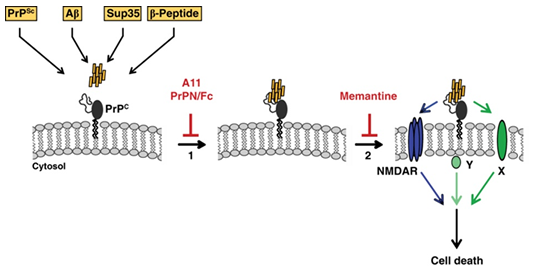
Putative model of oligomer-induced toxic signalling via PrPC. PrPC at the plasma membrane can physically interact with β-sheet-rich conformers of different origin, such as PrPSc, amyloid β (Aβ), yeast prion protein (Sup35) or designed peptides (β-peptide) (step 1). Interaction of PrPC with the β-sheet-rich conformers can be inhibited by an oligomer-specific antibody (A11), or a secreted version of the intrinsically disordered N-terminal domain of PrPC (PrPN/Fc). The PrP/β-sheet complex can then induce apoptotic signalling (step 2). Toxic signalling via PrPC is dependent on the GPI anchor of PrP and can be inhibited by the NMDA receptor antagonist memantine. Since PrPC has no direct contact to the cytosolic compartment, it is plausible to assume that intracellular signal transmission involves additional cellular factors, such as the NMDA receptor (NMDAR), or a different transmembrane protein (X), or a cytosolic protein associated with lipid rafts (Y).
ABSTRACT
Formation of aberrant protein conformers is a common pathological denominator of different neurodegenerative disorders, such as Alzheimer's disease or prion diseases. Moreover, increasing evidence indicates that soluble oligomers are associated with early pathological alterations and that oligomeric assemblies of different disease-associated proteins may share common structural features. Previous studies revealed that toxic effects of the scrapie prion protein (PrP(Sc)), a β-sheet-rich isoform of the cellular PrP (PrP(C)), are dependent on neuronal expression of PrP(C). In this study, we demonstrate that PrP(C) has a more general effect in mediating neurotoxic signalling by sensitizing cells to toxic effects of various β-sheet-rich (β) conformers of completely different origins, formed by (i) heterologous PrP, (ii) amyloid β-peptide, (iii) yeast prion proteins or (iv) designed β-peptides. Toxic signalling via PrP(C) requires the intrinsically disordered N-terminal domain (N-PrP) and the GPI anchor of PrP. We found that the N-terminal domain is important for mediating the interaction of PrP(C) with β-conformers. Interestingly, a secreted version of N-PrP associated with β-conformers and antagonized their toxic signalling via PrP(C). Moreover, PrP(C)-mediated toxic signalling could be blocked by an NMDA receptor antagonist or an oligomer-specific antibody. Our study indicates that PrP(C) can mediate toxic signalling of various β-sheet-rich conformers independent of infectious prion propagation, suggesting a pathophysiological role of the prion protein beyond of prion diseases.