

Content
Research Focus
In a recent study we used lentiviral RNA interference in primary neurons and identified the metalloprotease ADAM10 as the long-sought alpha-secretase (Kuhn et al., EMBO J. 2010; LMU Press release). This protease has a central role in preventing the molecular mechanisms underlying Alzheimer’s disease.

Figure 1: A single-span membrane protein is first cut within its ectodomain (ectodomain shedding) and then within its transmembrane domain.
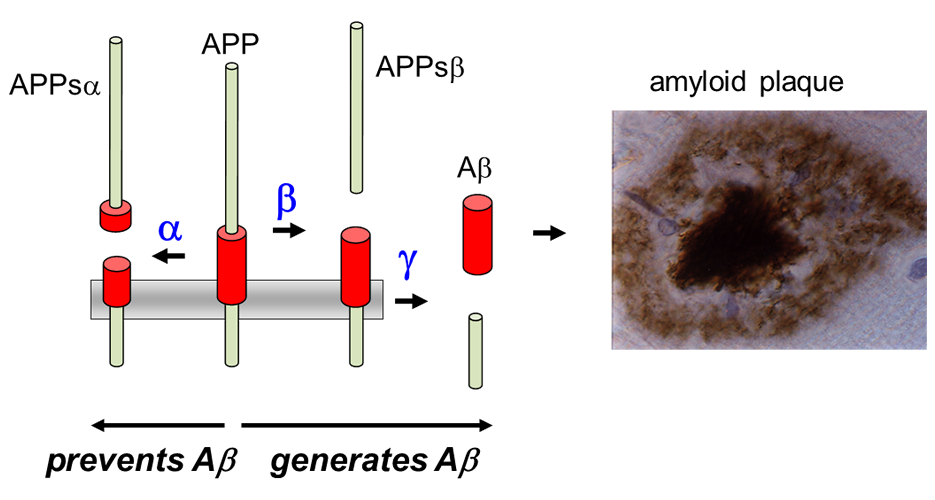
Figure 2: The combination of β- and γ-secretase leads to the generation of the pathogenic Aβ peptide, whereas the cleavage by α-secretase prevents Aβ generation and thus the mechanisms leading to Alzheimer's disease.
In general, we study how membrane proteins are proteolytically cleaved at the cell surface. This process is called regulated intramembrane proteolysis and is a basic cellular mechanism controlling the communication between cells and their environment. Regulated intramembrane proteolysis contributes to numerous biological processes, from signal transduction to cell adhesion and embryonic development. A dysregulation of regulated intramembrane proteolysis is associated with diseases, such as tumors, rheumatoid arthritis and Alzheimer's disease.
Regulated intramembrane proteolysis is a two-step proteolytic cascade. A single-span membrane protein is first cut within its ectodomain (ectodomain shedding) (Figure 1) and then within its transmembrane domain. An increasing number of proteins are substrates for regulated intramembrane proteolysis, including receptors (e.g. Notch), cytokines (e.g. TNFα) and the amyloid precursor protein (APP), which has a central role in the pathogenesis of Alzheimer's disease. Shedding of APP occurs by distinct proteases called α- or β-secretase. Intramembrane proteolysis is mediated by γ-secretase. The combination of β- and γ-secretase leads to the generation of the pathogenic Aβ peptide (Figure 2), whereas the cleavage by α-secretase prevents Aβ generation and thus the mechanisms leading to Alzheimer's disease.
We follow three lines of research. First, we study the molecular players - proteases, substrates and mechanisms - involved in regulated intramembrane proteolysis, in order to elucidate the biological function of this process, in particular in the nervous system. Second, we investigate how regulated intramembrane proteolysis is controlled in the cell and how it is dysregulated in disease. Third, we aim at identifying new ways to modulate the regulated intramembrane proteolysis in diseases, in particular in Alzheimer's disease. We identify new drug targets, test new pharmacological approaches and search for suitable biomarkers of the disease. Recently, we identified novel drugs, which block the beta-secretase cleavage of APP (Mitterreiter et al., J. Neurosci. 2010). These compounds are now used for further drug development against Alzheimer’s disease.
For our research, we use a variety of methods ranging from biochemistry to proteomics, for example quantitative mass spectrometry, lentiviruses, high-throughput cellular screens with siRNA and small molecules.